
What Is Whole-Home Audio and Is It Worth It for an NJ Home?
Last Updated on May 23, 2026 by PJ Windle
A lot of homeowners come to us already knowing they want music throughout their house. They just are not sure what to call it, how it works, or whether the cost makes sense for how they actually live.
Whole-home audio, whole house audio, multi-room audio, distributed audio — these all describe the same idea: a system that plays music, podcasts, or any audio source in multiple rooms simultaneously or independently, controlled from a single interface. No Bluetooth pairing. No separate speaker apps. No walking over to adjust the volume. Just music everywhere, managed simply.
This post breaks down what the system actually is, what it costs in New Jersey, what you need in your home to support it, and whether it is genuinely worth the investment.
TL;DR
Whole-home audio is a system that plays music in every room of your house, with each zone controlled independently from a single app or wall keypad. It is built into the home like any other infrastructure — not a speaker you move from room to room.
Here is what you need to know before deciding if it is right for your NJ home.
- Whole-home audio and multi-room audio mean the same thing: distributed sound throughout your house with independent zone control
- In-ceiling and in-wall speakers are the cleanest solution, but wireless options exist for homes where running new wire is not practical
- A professional system is not the same as a Sonos speaker on a shelf, even if Sonos is part of the install
- Most NJ homeowners who invest in a whole-home audio system say they use it every single day
- Cost varies widely based on the number of zones, speaker type, and whether the home is new construction or existing
- The system integrates with your smart home, so music follows you room to room without touching your phone
What Whole-Home Audio Actually Means
At its core, a whole-home audio system divides your house into zones. Each zone is a room or area with its own speakers and its own independent volume and source control. Zone one might be the kitchen playing a morning news podcast. Zone two is the master suite playing something quieter. Zone three is the backyard playing whatever everyone agreed on for the cookout. All three are happening at the same time, all managed from the same app or wall keypad.
That zone-based architecture is what separates a real distributed audio system from a Bluetooth speaker or even a Sonos speaker sitting on a bookshelf. Those are single-point solutions. A whole-home system is infrastructure, built into the house the same way your electrical or HVAC system is.
The speakers you do not see
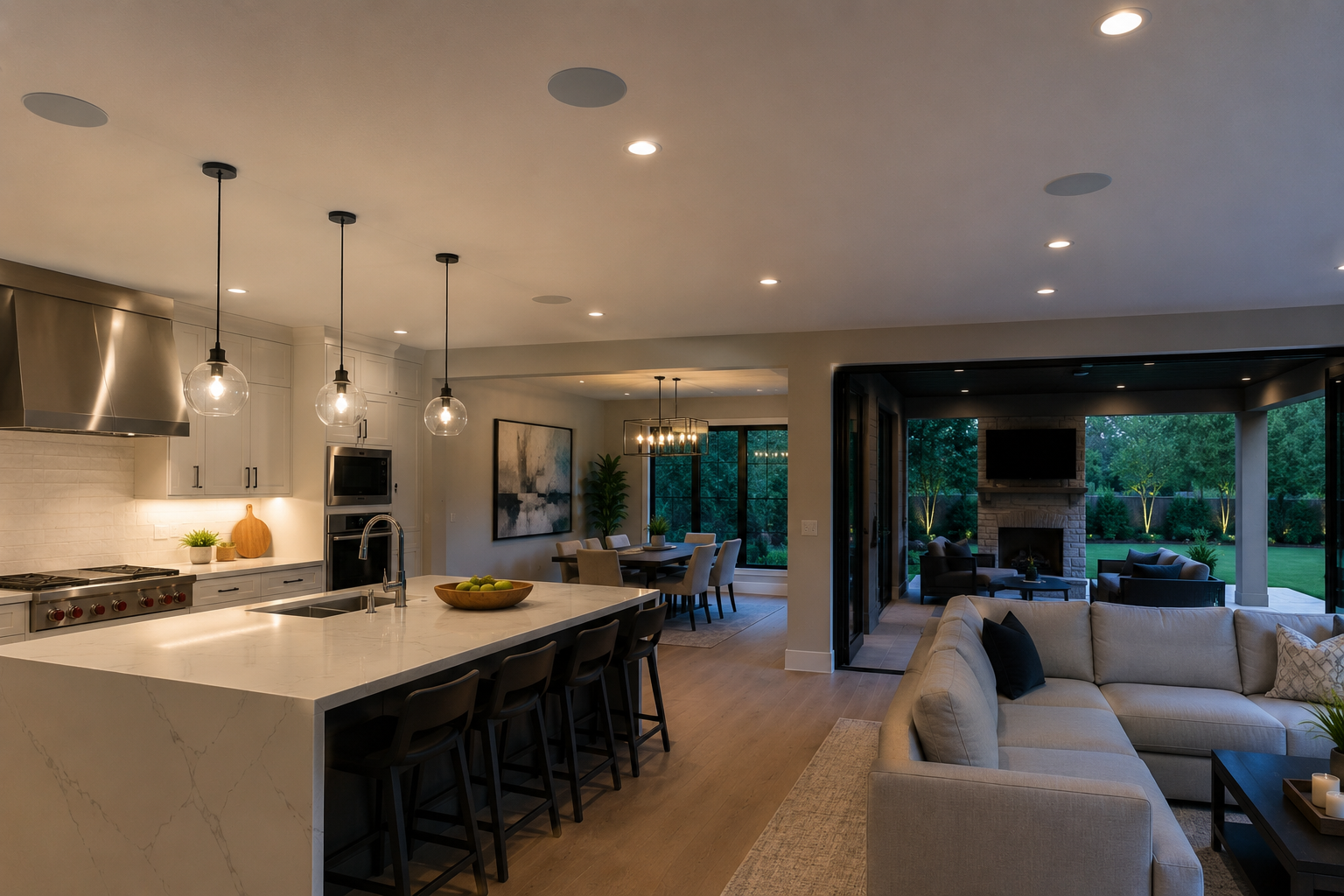
The most common speaker choice for whole-home audio in NJ homes is in-ceiling or in-wall speakers. These flush-mount into the ceiling or wall, sit behind a small paintable grille, and essentially disappear into the room. You hear sound coming from the ceiling the way you feel air from a vent. It is just there, ambient and clean, without a speaker cabinet sitting on a shelf or a wire running across the floor.
In-ceiling speaker installation works in most rooms in an existing home with access to attic space or the floor above. Rooms without that access, like a finished basement or a slab-on-grade addition, typically use in-wall speakers or a surface-mount solution instead. Every home is different, which is why we assess the structure before recommending anything.
The equipment behind the wall
The speakers are only part of the system. Behind the scenes, a whole-home audio setup includes an amplifier or multi-zone receiver that powers each zone, a source device that feeds audio into the system, and a control interface — either an app, a wall keypad, or both — that lets anyone in the house manage their zone without affecting anyone else. In a fully integrated smart home automation setup, all of this sits under a central control system alongside your lighting, shading, security, and climate.
Wireless vs. Wired: Which Is Right for Your Home
This is the question we get most often, and the honest answer is that it depends on your home and what you want the system to do.
Wired systems
A wired whole-home audio system runs speaker wire from each zone back to a central amplifier, typically housed in a structured wiring panel or equipment closet. This is the most reliable approach. There is no Wi-Fi dependency, no dropouts, no latency, and no compatibility issues between devices from different manufacturers. The audio quality ceiling is also higher because you are not compressing a signal to transmit it wirelessly.
The tradeoff is that running wire through finished walls takes more planning and, in some cases, more disruption during installation. In new construction, it is straightforward. In an existing NJ home, an experienced installer can run wire cleanly through attic space, interior wall cavities, and crawl spaces with minimal impact to the finished interior. It is rarely as invasive as homeowners fear.
Wireless systems
Wireless whole-home audio, most commonly Sonos-based, uses your home Wi-Fi network to stream audio to speakers placed around the house. Setup is simpler, installation is faster, and it is a strong fit for homes where running new wire is genuinely not practical.
The important distinction is that wireless speakers still need power. Every wireless speaker needs to be plugged in or hardwired for power, which means you still need an outlet in the right location. And the system is only as reliable as your home’s Wi-Fi network. If your Wi-Fi has dead zones or inconsistent signal, the audio system will reflect that.
For most NJ homes, the best outcome is a hybrid approach: wired in-ceiling speakers in the main living areas, kitchen, and primary suite where the listening experience matters most, and wireless where wiring is not practical, such as a detached garage, a screened porch, or a finished basement with no attic access above it.
What Does Whole-Home Audio Cost in New Jersey?
Cost is the question everyone has and nobody gives a straight answer to. Here is our honest breakdown.
A single-zone in-ceiling speaker installation, meaning one room or area with a stereo pair of in-ceiling speakers, basic amplification, and integration into an existing streaming source, typically starts around $800 to $1,500 installed. That covers a kitchen, a master bath, or an outdoor patio as a standalone zone.
A whole-home audio system covering four to six zones, common for a mid-sized NJ single-family home, with quality in-ceiling speakers, a multi-zone amplifier, a streaming source, and a control app, typically runs between $4,000 and $10,000 installed depending on speaker brand, room count, and how much wire needs to be run through finished walls.
A larger system covering eight or more zones, premium speaker brands, integration with a full Control4 or Savant control system, outdoor zones with weather-resistant speakers, and a dedicated equipment rack runs from $10,000 upward. This is the level where the audio system is one component of a complete smart home rather than a standalone upgrade.
The biggest variables in NJ specifically are the age and construction of the home. Older homes in Monmouth and Ocean County with plaster walls and limited attic access take more labor to wire than newer construction. We account for that in every estimate we provide, which is why we do not quote anything without a site visit first.
Is a Whole-Home Audio System Actually Worth It?
This is where we will be direct: of all the upgrades we install, whole-home audio has the highest daily use rate of anything we do. Homeowners who have it use it every day. Homeowners who are considering it are almost always glad they did it once it is in.
It changes how the house feels
Music throughout a home changes the atmosphere in a way that is hard to describe until you experience it. Morning routines feel different. Dinner parties feel different. A Sunday afternoon with music drifting from the kitchen to the back porch through the living room just feels like a better version of home. It is one of those improvements that is hard to quantify but immediately felt.
Everyone in the house uses it independently
Because each zone is independent, there is no negotiation about what plays where. One family member has the news on in the kitchen. Another has a playlist going in their room. Nobody is fighting over the Bluetooth speaker or waiting for someone else to be done with it. That alone eliminates a surprising amount of friction in daily life.
It connects to everything else
When whole-home audio is part of a smart home automation system, it starts doing things on its own. Music plays when you wake up. It pauses when the doorbell rings. It fades out when you arm the alarm to leave. The lights dim and music starts when you tell the system you are watching a movie. These are not gimmicks. They are genuinely useful automations that make the system feel like part of the house rather than a gadget you have to manage.
It adds to resale value
Built-in audio infrastructure is a meaningful differentiator in the NJ real estate market, particularly in Monmouth and Ocean County where buyers at higher price points expect smart home features. Unlike a freestanding speaker that leaves with the seller, in-ceiling speakers and a wired audio system stay with the house and carry demonstrable value.
How Whole-Home Audio Works With Your Smart Home
A whole-home audio system can function as a completely standalone upgrade. But it reaches its full potential when it is integrated with the rest of the home. Some examples of what that looks like in NJ homes we have set up:
- A “Good Morning” scene triggers at 7 AM: kitchen lights come on gradually, the thermostat adjusts, and a morning playlist starts in the kitchen and primary suite at a low volume
- The doorbell rings and music pauses automatically in every zone, then resumes after 30 seconds if no one answers
- A “Movie Night” scene dims the living room lights, lowers the motorized shades, and switches the audio system from whole-home music to home theater mode with one tap
- Leaving the house arms the security system, locks the doors, and turns off every audio zone simultaneously
- Outdoor speakers activate when the back door opens during a party, matching what is playing inside
None of these require any technical knowledge from the homeowner. They are scenes set up once during installation and then just work.
What to Expect From the Installation Process
For an existing NJ home, a whole-home audio installation typically follows this sequence:
- Site visit to assess the home’s structure, determine wire routing paths, identify zone locations, and understand how the system will connect to existing infrastructure
- System design covering zone layout, speaker selection, amplifier and source equipment, and control interface
- Wire run day, which involves pulling speaker wire through walls, ceilings, and attic space to each zone location and back to the central equipment location
- Speaker and equipment installation, including mounting in-ceiling or in-wall speakers, installing the amplifier and streaming source, and connecting everything to the control system
- Programming and calibration, setting up zone names, source routing, automation scenes, and volume levels for each room
- Walkthrough with the homeowner so everyone in the household knows how to use every feature
A four to six zone installation in an existing home typically takes one to two days depending on the complexity of the wire runs. New construction installs are faster because walls are open during the rough-in phase.
The walkthrough at the end is something we take seriously. A system that a homeowner cannot confidently use is a system that sits idle. We do not hand over a system until everyone in the house is comfortable with it. — PJ Windle, AV Advisor NJ
Common Questions From NJ Homeowners
Can I add whole-home audio to my existing home without tearing up walls?
In most cases, yes. An experienced installer can route wire through attic space, interior wall cavities, and existing chase paths with minimal disruption to finished surfaces. Wireless is also always an option if wiring truly is not practical.
Can I use Spotify, Apple Music, or Tidal with a whole-home audio system?
Yes. All major streaming platforms are compatible with the most common whole-home audio platforms. The system pulls from whatever streaming service you already use, or you can connect multiple services and choose per zone.
What happens if the internet goes down?
A wired system with local source material continues to work without internet. A system that depends entirely on cloud streaming will be interrupted until connectivity is restored. We design systems with this in mind and can configure local backup sources for households where that continuity matters.
Can I expand the system later?
Yes, and it is one of the reasons we recommend installing a slightly more capable amplifier than the current zone count requires. Adding a zone to an existing system is straightforward if the infrastructure was planned with expansion in mind.
Do outdoor speakers work through NJ winters?
Weather-rated outdoor speakers are designed for year-round use including freeze-thaw cycles, humidity, and direct sun exposure. We use speakers rated for the specific outdoor environment, whether that is a covered porch, an open patio, a poolside area, or a landscape installation.
Ready to Hear What Your Home Could Sound Like?
We design and install whole-home audio systems for NJ homes of every size. Start with a free consultation and we will tell you exactly what makes sense for your space and budget.
Keep Reading